
Caves

 Source: Gillieson (1998) -Caves : Processes, Development, and Management
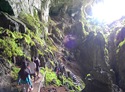
Here's a cave system. The red part is what we saw in fairy caves. There's actually a whole system above and below the cave we were in (blue).
The top part shows rain and trees right? Rain water, when dissolved with carbon dioxide in the air becomes mild carbonic acidic. The acid from decomposing plants make it even more acidic.
This acidic rainwater seeps through the limestone and dissolves it.
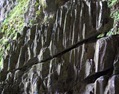
When this water drips into the cave, some of the dissolved limestone is left behind. Over many thousands of years, the deposited limestone forms a stalactite (c for ceiling). The water that drips to the ground also deposits limestone, forming a stalagmite (g for ground) over time. If these 2 join after many years, it becomes a cave column.
Cave eco-system

Caves are sensitive eco-systems because of the lack of light. Species deep inside have adapted to the system. The insects are blind and have no skin pigment. Alot of them also rely on the bat guano (bat shit) to survive.
 River discharge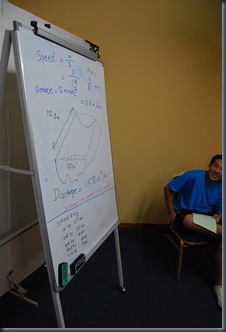
 River discharge
Measuring river discharge is like measuring volume. (length x breadth x height)
But in this case, the height (depth of river) is uneven. That's why we measure the depth at several points and calculate the area.
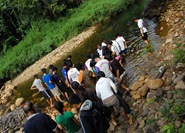
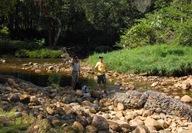
We recorded the speed of the water flow using ping pong balls. This was to calculate the "length" of water flowing through the river at the point per minute.
Using this "length" and area, the volume discharge per minute is cross section area x speed of river.
An example: If the ping pong ball moves 20 metres in 1 minute, it means the "length" is 20 metres. We multiply this by the cross-sectional area (10m square) and the discharge (volume) is 200m cube per minute.
Never mind the exact steps in measuring discharge. At least you guys saw how it was done. Now... how is discharge applicable in real life?
Discharge increases after rainfall since all the rainwater from the top of the mountain rushes down in streams and joins the river. So when you see that there's rain, keep away from the river!
This is the case in Singapore canals too. The water level at Old Airport Road canal may seem low but can increase suddenly because it just rained at Marine Parade and all the drains are bringing water into the canal and then down into Kallang River. So don't ever play in canals. It may look safe but floods can come anytime!
Take-away message
Caves are amazing natural structures with beautiful formations like stalactites. They support a whole eco-system that has adapted itself to a world without light. All these take millions of years to evolve.
Measuring river discharge is like measuring volume of a cuboid. The exact steps are just for basic information. What you need to know is that discharge can suddenly increase because multiple streams (drains in the case of urban Singapore) contribute rain water to the main river. If this discharge exceeds the capacity of the river, it will flood.
Good to read
Giant Caves of Borneo - Very easy to read book with lots of photos. Tells you more about what's inside caves. Focuses on Sarawak caves.
http://vistaweb.nlb.gov.sg/cgi-bin/cw_cgi?fullRecord+27045+3002+6313596+1+3
The World of Caves - Many photos of how caves are used by humans all over the world.
http://vistaweb.nlb.gov.sg/cgi-bin/cw_cgi?fullRecord+27045+3002+745018+1+9


No comments:
Post a Comment